REPUBLIC OF KOREA NATIONAL ELECTION COMMISSION

Special Exhibition Room

National Election Commission

The Election Commission (NEC) has a four-stage organizational structure, consisting of the National Election Commission, 17 Si/Do election commissions, 250 Gu/Si/Gun election commissions and 3,481 Eup/Myeon/Dong election commissions. Overseas Voting Committee is temporarily established at overseas embassies for the presidential election and the National Assembly elections to be conducted following the termination of office.

National Election Commission

Commission
Composition

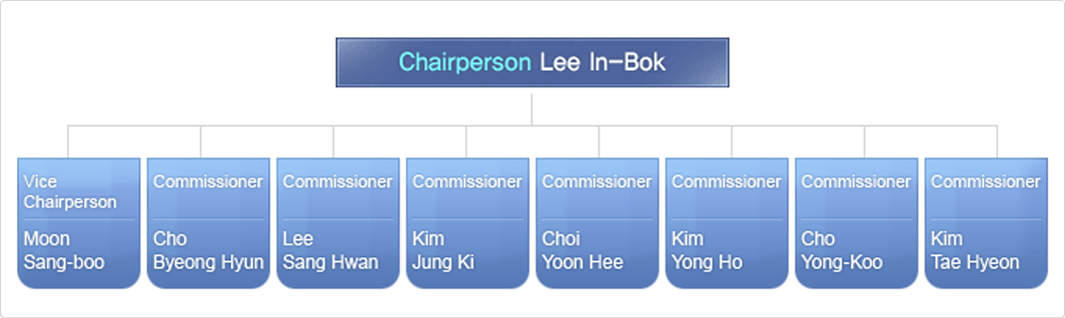
The National Election Commission is an independent constitutional agency composed of 9 members. 3 members are appointed by the president, 3 elected by the National Assembly and 3 nominated by the Chief Justice of the Supreme Court. The Chairperson and the Standing Commissioner are elected from among the Commissioners and as is its custom, the Justice of the Supreme Court is elected to be the Chairperson. The Standing Commissioner of State Minister level is a full-time position unlike the Chairperson, supports the Chairperson and oversees the Secretariat as directed by the Chairperson. 6 year term of office is guaranteed by the constitution. The Secretariat, the Internet Election News Deliberation Commission and the Election Debate Broadcasting Commission are the NEC’s affiliated institutions.

Introduction of National Election Commission Members

The term of office of the members of the Commission shall be six years. No member of the Commission shall be expelled from office except by impeachment or a sentence of imprisonment without prison labor or heavier punishment. The members of the Commission shall not join political parties, nor shall they participate in political activities. The Commissioners endorsed by the National Assembly shall have a social position of that of general Commissioners.
cont_01
Secretariat

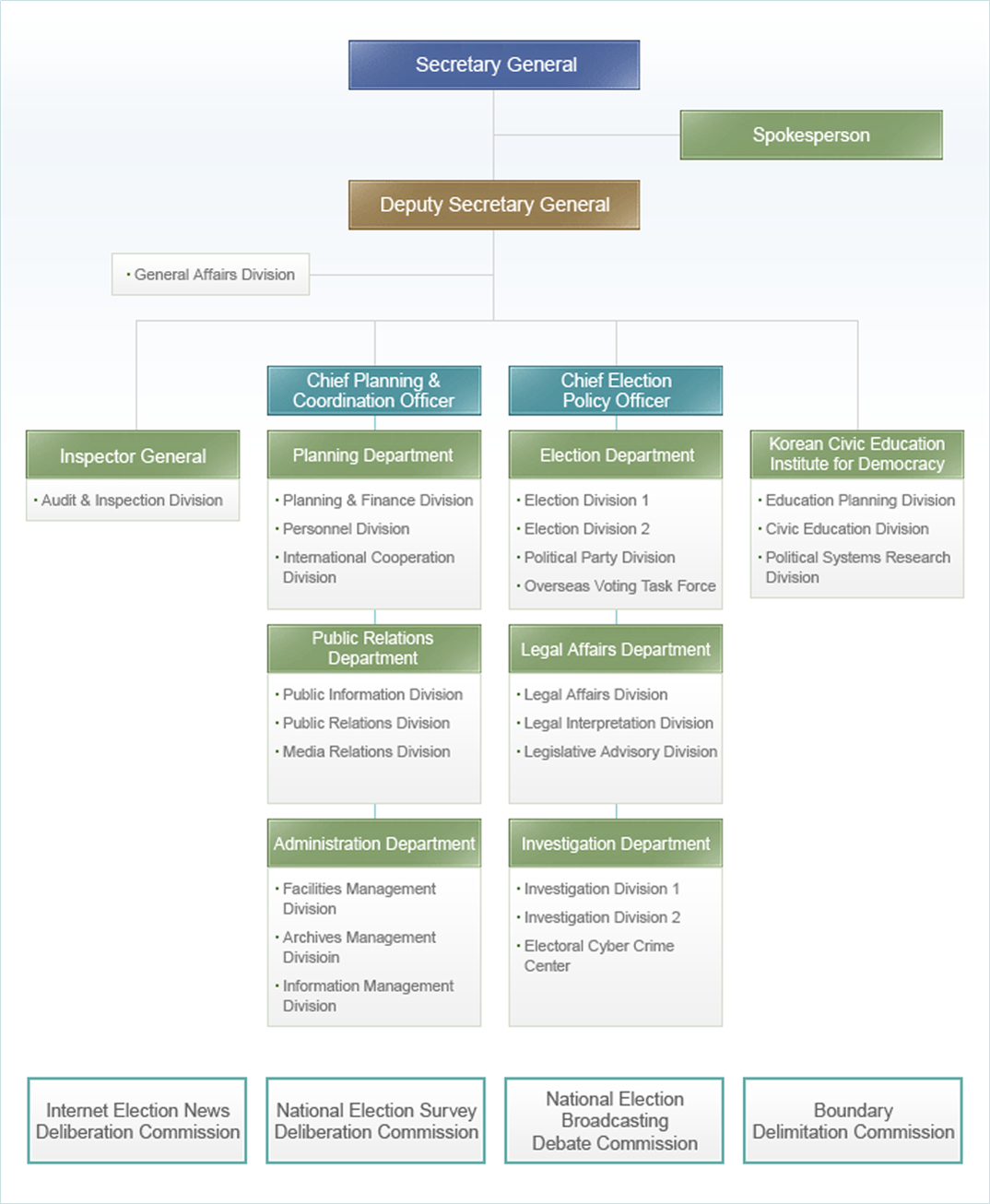
The Secretariat is composed of the Secretary General of State Minister level and the Deputy Secretary General of Vice Minister level in addition to two offices, twenty five divisions and one training institute. Its employees are equal in status with government officials. Human resources matters including employment, promotion, appointment and transfer are managed autonomously to maintain independence in human resources management.
cont_02

Si/Do ECs

Si/Do Election Commission

Commission

Si/Do Election Commissions are composed of the Chairperson, the Standing Commissioner and Commissioners. Each political party that has a negotiating group in the National Assembly recommends one person (who has a voting right and is not a member of any political party) as a Commissioner. Three members including two judges are recommended by the Chief Justice of a Local District Court and another three members are nominated from a pool of scholars and individuals known for high academic and ethical standards. The Chairperson of the Commission is elected from among the members and customarily the Chief Justice of a District Court is elected the Chairperson. The Standing Commissioner is nominated by the National Election Commission and serves full-time.

Under each Si/Do Election Commission are a secretariat and the Election Broadcasting Debates Commission.

Secretariat

The Secretariat consists of the Standing Commissioner, the Director General and Four Divisions.

organ02_02

Gu/Si/Gun ECs

Si/Do Election Commission

Commission

Gu/Si/Gun Election Commissions are composed of the Chairperson, the Deputy Chairperson and Commissioners.
The Gu/Si/Gun Election Commission currently has two members endorsed by the political parties having a negotiation body in the National Assembly and six members commissioned by the Si/Do Election Commission from among judges, educators or persons known for their high academic and ethical standards.
The Chairperson and the Deputy Chairperson are elected from among the Commissioners and as is its custom, the Judge is elected to be the Chairperson. No Commissioner holds a full-time position.
The Gu/Si/Gun Election Commission has the Secretariat and the Election Debate Broadcasting Commission within the organization.

Secretariat

The Gu/Si/Gun Election Commission that manages the National Assembly constituencies has an Executive Bureau, otherwise, an Executive Division within the organization.
An Executive Bureau/Executive Division consists of the fourth grade (fifth grade) Director General of Secretariat and two divisions.

organ03_02

Eup/Myeon/Dong Election Commissions

Commission

Eup/Myeon/Dong Election Commissions are composed of the Chairperson, the Deputy Chairperson and Commissioners.
Political parties that can constitute a negotiation body in the National Assembly endorse two members among those who reside in the Eup/Myeon/Dong and have the right to vote for members of the National Assembly but who are not members of any political party. The Gu/Si/Gun Election Commission appoints the other four members among the persons of learning and high moral repute. The Chairperson and the Deputy Chairperson are elected from among the Commissioners. No Commissioner holds a full-time position.


Executive organs

The Eup/Myeon/Dong Election Commission elects secretaries and clerks among local government officials to provide administrative support to the Election Commission. In addition, returning officers selected from among public officials or faculties are assigned to constituencies, where they are required to manage administrative duties pertaining to voting.

Internet Election News Deliberation Commission


Internet Media and Responsibility for Fair Election News


Internet Media and Increasing Opportunity to Participate in Politics

The Internet has caused a tremendous change in the media environment in various aspects of production, delivery, and consumption of news. In particular, the Internet media is becoming an effective medium for the public to participate in politics while several elections are held and it has a great influence on all fields.


Rising Influence of Internet Media on Politics and its Disadvantages

The Internet media offers a variety of political information to voters, activates a debate culture, draws people”s attention to election and encourages voters to participate in politics. It is also used as a space for exchanging opinions on civil society. In spite of advantages of the Internet media, it also causes various problems. For example, unfair election news coverage may do damage to political parties and candidates or distort voters” perspectives of the information delivered.


Fair Election News Coverage by Internet Media

With the influence of the Internet media on society and politics being greater, people have started feeling keenly the necessity of impartial internet election news. Thus, through the revision of the Public Official Election Act on Mar. 12, 2004, the Internet Election News Deliberation Commission was established to relieve the damages caused by distorted election news coverage on political parties and candidates and encourage fair election news coverage by the Internet media.


Internet Election News Deliberation Commission

According to the Article 8-5 Paragraph (2) of the Public official Election Act, the Internet Election News Deliberation Commission is composed of less than 11 commissioners endorsed by the political parties that hold a negotiation body in the National Assembly, the Korea Communications Standards Commission, the Press Arbitration Commission, the National Election Commission, academic and legal circles, the Internet media associations and civic groups.


Secretariat

According to the Article 8-5 Paragraph (8) of the Public official Election Act, the Internet Election News Deliberation Commission operates a qualified deliberation team, a deliberation management team and deliberation support team to handle deliberation duties.

Duties & Responsibilities


Countermeasures against Damage


Deliberates a Formal Objection against Unfair Election News

A political party or a candidate may file an objection with the Internet News Deliberation Commission against the election news delivered by the Internet media whose coverage is believed to be unfair within 10 days after noticing the news. Once an objection is lodged, the Internet News Deliberation Commission deliberates without delay whether the election news that an objection has been lodged against is fair or not. If it is admitted that the election news is not fair, the Internet News Deliberation Commission shall request a correction on the news report to minimize damage.


Deliberates a Request for Correction against the Distorted News Coverage

-In case a political party or a candidate has put in a request in writing for correction report to the corresponding Internet media within 10 days after noticing the election news and an agreement has not been reached, the corresponding political party or the candidate concerned may request a correction to the Internet News Deliberation Commission.
The Internet News Deliberation Commission deliberates the request, makes a decision on the requirement for news coverage and orders the corresponding Internet media to correct the news.


Maintaining Fair Election News Coverage

-In accordance with Article 8-6 of the Public Official Election Act, the Internet News Deliberation Commission investigates if the election news posted on the websites of Internet media is impartial. Once the election news covered by the Internet media is found to have damaged fairness, the Internet News Deliberation Commission takes actions that include ordering the corresponding Internet media to post a correction report (posting of a warning & caution notices/requests for cooperation regarding the fair news coverage).


Research Activities


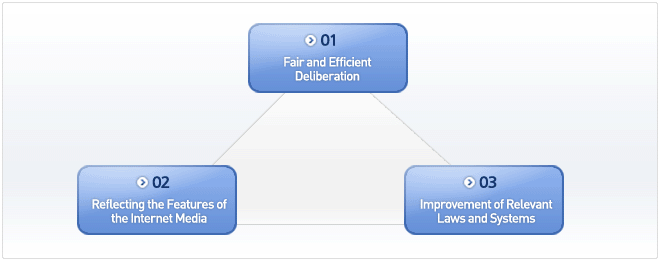
Various Research Activities for Fair and Efficient Deliberation

Improvement of Relevant Laws and Systems
The Internet News Deliberation Commission strives to achieve the development of the Internet media and provide a right direction to fair news coverage.

IENDC02_img03

Research on Fair Efficient Deliberation into Internet Election News

The Internet Deliberation Commission undertakes various researches to fairly deliberate an objecton lodged against unfair election news coverage and a request for a correction of news.


Research on Establishment of Deliberation Criteria that Reflect the Features of the Internet Media

establish deliberation criteria that reflect the features of the Internet media and publishes White Papers and reports on deliberation outcomes.


Research on Improvement of Relevant Laws and Systems

The Internet Election News Deliberation Commission carries out researches to improve the relevant laws and systems for fair and efficient deliberation into election news coverage by the Internet media.

Principles of Fair Election News


Fair Election News Coverage

Unfair election news coverage by the Internet media may cloud voters” judgment, which will eventually lead them to making an improper decision on important matters affecting the future of nation. Therefore, if democracy is based on the right choice made by the public, fairness of election news coverage is the core of democracy.

□ With the Internet Election News Deliberation Commission keeping balance in quantity and quality of news
coverage, no specific candidate or political party shall not be benefited or sustain damage.


Fact-Based Election News Coverage

Delivery of incorrect information on a candidate/political party or the election-related information distorted by political and economic power may hinder voters from making a proper decision or casting a correct vote. The election news coverage should therefore be based on the fact to enable voters to make a correct decision when voting.

□ Media reports must be based on the fact and the election news reports, in particular, must be more fact-based
given that an election legitimizes the national authority according to the democratic procedure.


Voter-oriented Election News Coverage

The major role of the media in the field of elections is to assist voters in selecting the best candidate. The media therefore focus on the delivery of information that voters wish to and must know, do an in-depth analysis of issues for coverage and eventually help voters fully understand electoral circumstances and make a proper decision.


Policy-Oriented Election News Coverage

The media shall neither simply compare messages produced by a candidate or a political party for public promotion nor do focused coverage of visual factors such as candidates” appearance, accent, behaviors for show, etc. The media shall compare and analyze differences in pledges and policies of candidates and political parties to enable voters to figure out which candidate delivers which pledge. The media shall also deliver election news to verify whether policies and argument of candidates and political parties are feasible and true.


Improvement of Election Culture

The media shall enable voters to think about significance of elections and encourage them to vote by providing the meaning of elections and significance of participating in elections.
In addition, the media shall enable voters to understand the significance of being elected through fair competition based on policies and rules rather than illegal election campaigns such as defamation and scandal exposure.


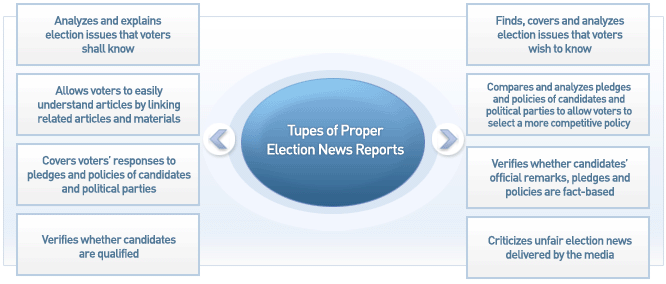
Types of Proper Election News Report

IENDC04_img01

Examples of Unfair Election News


News Report Focused on a Specific Candidate

– A remarkably large quantity of articles or photos of a specific political party or candidate
– Interviews conducted in favor of a specific candidate to highlight his/her accomplishments and positive images
– Delivery of the contents of interviews which may have a positive/negative effect on a specific candidate during the introduction of electoral atmosphere in specific areas
– Promotional news articles that cover a specific candidate”s career, political activities, pledges, political views, etc.
– Dialogues or debates broadcast intentionally to highlight or disparage a specific candidate prior to an election


News Report on Unidentified Information

– News report on a candidate containing the information irrelevant to the candidate or unidentified information
– Conclusive news report on arguments raised by the opposing candidate or political party without verification


Exaggeration, Minimization, or Concealment of Information

– News report that exaggerates, minimizes or conceals important facts which may affect voters” judgment
– Conclusive news articles that predicts the election result without any reasonable grounds to mislead voters” judgment


Unfair Report on Public Opinion Polls

– News report including results of public opinion polls from unknown sources that may have a positive/negative impact on a specific candidate
– News report on results of public opinion polls interpreted arbitrarily for or against a specific candidate
– News report on unscientific survey results without representative samples
– News report on survey results during the prohibition period for releasing survey results

National Election Broadcasting Debates Commission


Purpose

The National Election Commission (NEC) established the National Election Broadcasting Debates Commissions (NEBDC) in 2004 according to the Article 8-7 (National Election Broadcasting Debates Commission) of the Public Official Election Act to fairly manage and operate interviews and debates according to the Article 82-2 (Interview and Debates managed by the National Election Broadcasting Debates Commission) and policy debates according to the Article 82-3 (Policy Debates managed by the National Election Broadcasting Debates Commission).


Vision

EDBC01_img01

Organization

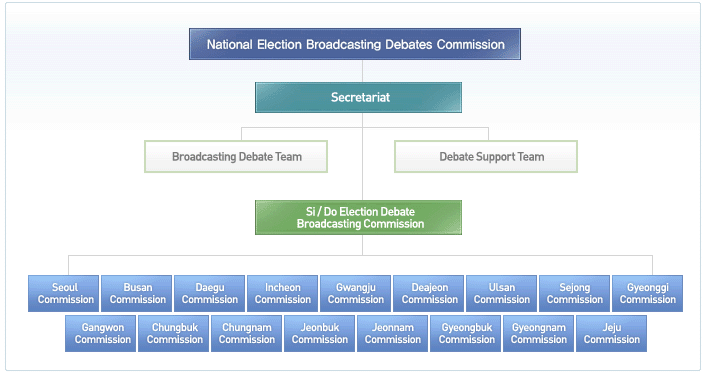
img

The Election Broadcasting Debates Commission (EBDC) is organized in each Si/Do and Gu/Si/Gun. Si/Do EBDCs are composed of 9 members (11 people in the case of the NEBDC) or less. Commission members are drawn from multiple sources of manpower. These include one person each from political parties which have a negotiation body within the National Assembly and public broadcasters. Other Commissioners include individuals endorsed by the Korean Broadcasting Commission, academic and legal circles, and civic groups, who are known for their high academic and ethical standards. Their 3 year term of office is guaranteed.

Each EBDC (whether National, Si/Do or Gu/Si/Gun) has one chairperson who is elected among Commissioners. A political party member shall not be a Commissioner of an NEBDC. The National Election Broadcasting Debates Commission (NEBDC) has a full-time Commissioner who is appointed by the National Election Commission.

Duties & Responsibilities


Election Broadcasting Debates Management


Manage the Interviews and Candidate Debates

– Presidential election and elections for proportional representation members of the National Assembly

– Elections of Heads of Si/Do Governments and proportional representation members of Si/Do Councils

– Elections for local district representatives of the National Assembly and heads of Gu/Si/Gun Governments


Manage Policy Debates

– Policy debates according to the Public Official Election Act

– Policy debates according to the Political Parties Act


Nurture Political Dialogues among Citizens


Provide education and training to nurture a debate culture among citizens

Work with the media to facilitate interviews and debates among candidates

Undertake Research on the System and Technique of Debates

Research and develop debate techniques

Election Broadcasting Debates


Meaning of Election Broadcasting Debates

As a formal type of argument, a debate requires giving an equal opportunity and time to people by imposing a certain format that encourage specific issues to be argued systematically. A TV debates has the following two aspects:


In terms of a political debate, if candidates participate in a TV debate, they can present their policies or plans or oppose the opinions of other candidates. This helps voters choose a proper candidate. The process promotes a political debate and is a basis of democracy.


A TV debate is considered as an opportunity for voters to examine policies and images of candidates.


Types of Election Broadcasting Debates


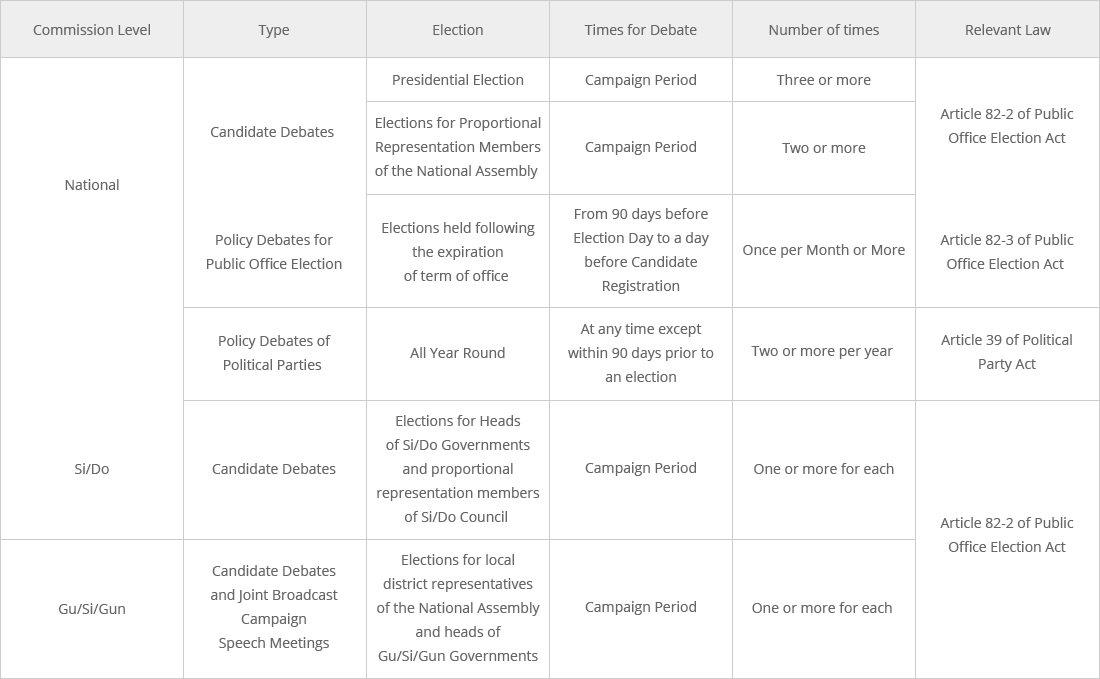
According to the Public Official Election Act and the Political Parties Act, the types of Election Broadcasting Debates managed by the NEBDC are described in the table below.

table